
The average website converts 2–3% of visitors. But average is not the same as good — and the gap between average and top performance is costing most businesses more than they realise.
You finally have traffic coming to your website. Paid ads running. SEO building. People landing on your pages.
But what does it actually mean for your business if 2 in every 100 visitors take action — and the other 98 leave?
It depends entirely on what good looks like for your industry, your business model, and your goals.
This guide breaks down website conversion rate benchmarks by industry, explains what separates average performers from the top 10%, and gives you a clear picture of where to focus if your numbers are not where they need to be.
What Is a Website Conversion Rate?
Your website conversion rate is the percentage of visitors who complete a desired action — filling out a form, booking a call, starting a chat, making a purchase, or any other step that moves them toward becoming a customer.
The formula is simple:
Conversions ÷ Total Visitors × 100 = Conversion Rate %
If 8,000 people visit your website this month and 160 of them book a call or submit a form, your conversion rate is 2%.
Simple enough. But what does 2% actually mean? Is that good, bad, or average?
The answer is: it depends on your industry.
What Is a Good Website Conversion Rate? — The Benchmark Picture
Before breaking it down by industry, here is the overall benchmark landscape:
| Performance Level | Conversion Rate |
|---|---|
| Average across all industries | 2–3% |
| Top-performing websites | 5–11% |
| Best-in-class (top 10%) | 11%+ |
| Bottom quartile | Below 1% |
The uncomfortable reality: most businesses accept 2–3% as normal and stop there. But the difference between a 2% and a 5% conversion rate — on the same traffic — is not a small improvement. It is 150% more leads, calls, and revenue without spending an extra pound or dollar on acquisition.
That gap is entirely within reach for most websites. It is not a traffic problem. It is a conversion problem.
Website Conversion Rate Benchmarks by Industry
B2B Lead Generation
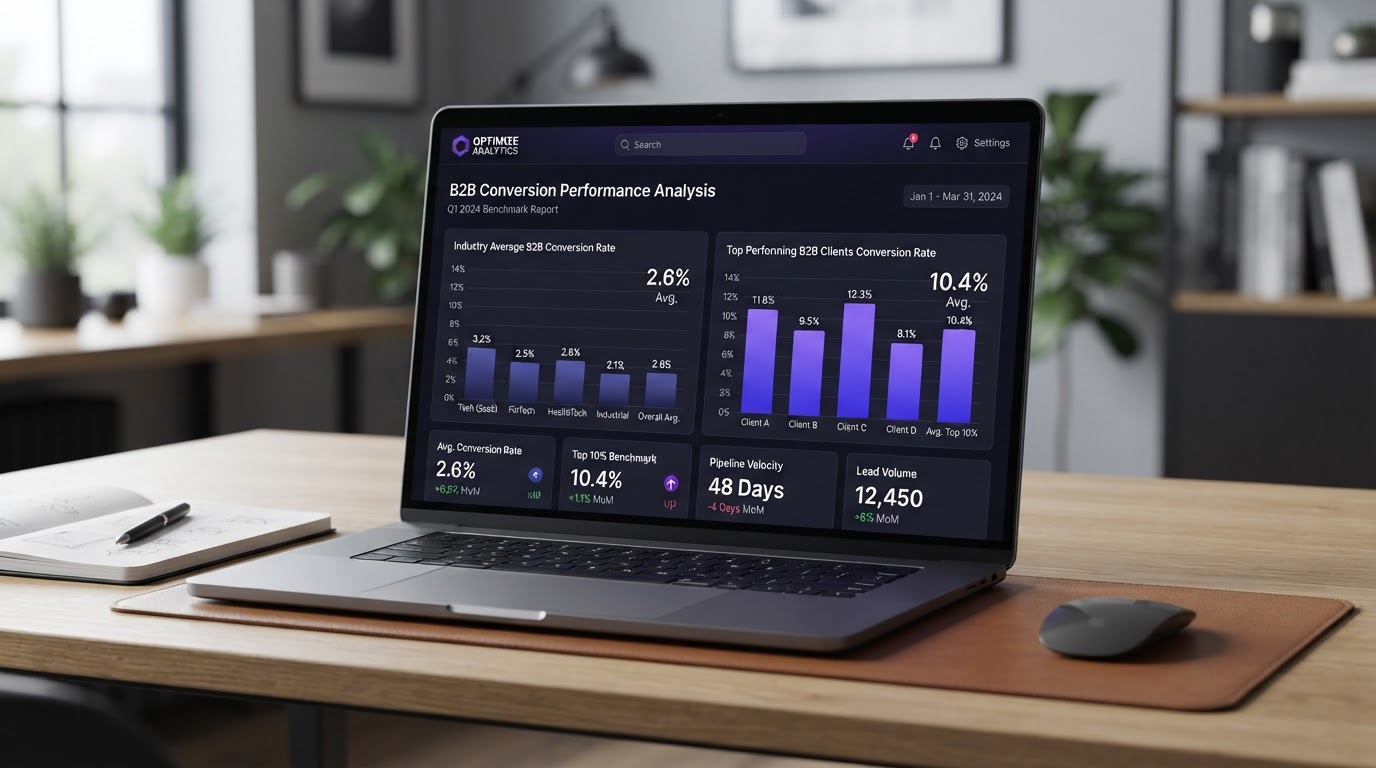
Average: 2–5%·Top performers: 8–12%
B2B lead generation sites face a unique challenge: the buying cycle is long, the decision involves multiple stakeholders, and visitors rarely convert on the first visit. The websites that outperform in this category share a common trait — they do not rely on a static contact form as their only conversion mechanism. They give every visitor an immediate, frictionless way to ask a question, start a conversation, or book a call in real time.
SaaS and Software
Average: 3–5%·Top performers: 8–15%
SaaS websites tend to outperform other B2B categories because the product itself can often be experienced before a buying decision — through free trials, demos, or interactive product tours. Conversion rates at the top end of this range are almost always driven by a combination of a clear value proposition above the fold, a single dominant CTA, and a live engagement channel that catches high-intent visitors before they leave.
Professional Services
Average: 3–5%·Top performers: 7–11%
Professional services firms rely heavily on trust before conversion. Visitors need to believe you can solve their specific problem before they will pick up a phone or submit a form. The highest-converting professional services websites build that trust rapidly — through specific case evidence, clear positioning, and a low-friction first step (a call, an audit, a free assessment) rather than a generic contact us page.
E-commerce
Average: 1–4%·Top performers: 5–8%
E-commerce conversion rates are heavily influenced by traffic source, product category, price point, and brand recognition. Paid traffic typically converts higher than organic for e-commerce, and remarketing audiences convert significantly higher than cold traffic. The sites at the top of this range invest heavily in page speed, mobile experience, and post-add-to-cart flow optimisation.
Real Estate and Property
Average: 2–3%·Top performers: 5–9%
Real estate is a high-consideration, high-value purchase category where most visitors are early in their journey. The conversion action for real estate sites is rarely a purchase — it is an enquiry, a viewing request, or a valuation. Sites that offer immediate live chat or WhatsApp engagement see measurably higher enquiry rates because they capture visitors at the peak of their browsing intent rather than waiting for them to find the contact form.
Education and Online Courses
Average: 3–6%·Top performers: 10–15%
Education conversion rates vary dramatically based on price point and commitment level. Free or low-cost courses convert at the high end of this range. Premium, higher-commitment programmes convert lower but produce higher revenue per conversion. The highest-performing education sites use urgency, social proof, and live chat to answer objections in the moment — reducing the I'll think about it drop-off that kills conversion in this category.
Healthcare and Medical
Average: 3–5%·Top performers: 7–10%
Healthcare websites convert best when they reduce friction around booking. Patients and clients want to take action immediately when they need help — but complex booking forms, unclear next steps, and the absence of real-time communication can interrupt that intent. The highest-converting healthcare sites make it possible to book an appointment, start a webchat, or send a WhatsApp message in under 30 seconds from any page.
Financial Services
Average: 5–10%·Top performers: 12–20%
Financial services sites that convert well have typically mastered one thing: matching their conversion offer to the visitor's stage of awareness. A lead who is already looking for a specific financial product converts much higher than a lead still researching broadly. Segmented landing pages with specific offers, clear trust signals, and immediate human or AI-chat availability consistently outperform generic financial homepages.
What Separates Top-Converting Websites From Average Ones
Across every industry, the websites that consistently outperform share the same characteristics. It is not their design budget. It is not the volume of traffic they receive. It is how well they are built to convert the visitors who actually show up.
1. Every Visitor Has an Immediate Path Forward
Top-converting websites do not leave visitors to figure out the next step. Above the fold, there is one clear, benefit-led CTA that tells the visitor exactly what happens next and why it is worth doing. Not Contact Us. Not Learn More. Something specific that answers the visitor's unspoken question: what do I get if I click this?
2. Real-Time Conversation Is Available on Every Key Page
The fastest single improvement most websites can make is adding a real-time conversation channel — live chat, WhatsApp, or webchat — to their highest-traffic pages. Visitors who have questions leave when there is nobody there to answer them. A 30-second live chat exchange that converts a hesitant visitor into a booked call is worth more than any homepage redesign. Landing pages with live chat convert up to 45% higher than those without.
3. The Website Is Built Around the Customer Journey
Most websites are built around what the business wants to say. The highest-converting websites are built around how a buyer actually makes a decision. Each section of each page answers the exact question a visitor is asking at that moment in their journey — from first awareness through to the decision to take action. When a website is structured this way, friction disappears and conversion follows naturally.
4. All Engagement Channels Connect Into One System
A visitor might find you through Google, research you on LinkedIn, see a retargeting ad, land on your website, and start a WhatsApp conversation — all before speaking to a human. If those touchpoints are disconnected, leads fall through the gaps between systems. The highest-converting websites connect live chat, WhatsApp, webchat, phone, and CRM into one platform so every lead is captured, followed up with automatically, and never lost.
5. The Technical Foundation Does Not Break the Experience
Page load time. Mobile responsiveness. Forms that submit correctly. Navigation that never leaves a visitor stranded. These are not glamorous improvements — but a website that loads in under 2.5 seconds, works perfectly on any device, and never breaks a form submission will outperform a visually impressive but technically broken website every time.
What to Do If Your Conversion Rate Is Below the Industry Benchmark
If your numbers are below the average for your category, the problem is almost always one of three things:
1. No real-time engagement channel.
Visitors have questions and leave because nobody is there to answer them. Adding live chat, WhatsApp, or webchat to your highest-traffic pages is the fastest path to measurable improvement.
2. No clear next step.
Your homepage or landing pages have too many competing options, or the single most important CTA is buried, weak, or unclear. Simplifying to one dominant action and making it impossible to miss will move your numbers quickly.
3. The website is not built for conversion.
Some websites have a structural problem — their messaging, their customer journey, their visual hierarchy — that cannot be fixed by adding a chat widget. If your site was built years ago without conversion in mind, a conversion-focused redesign is often the highest-ROI investment you can make.
How SmartReach AI Helps Close the Conversion Gap
SmartConvert combines every conversation channel your website needs — live chat, WhatsApp, webchat, phone, and CRM — into one AI-powered platform. Every visitor who lands on your site has a clear, immediate path to becoming a lead or customer. And every lead that comes in is captured, followed up with automatically, and never lost between disconnected tools.
If the problem goes deeper — if your website itself is not built around the customer journey, lacks clear CTAs, or was never designed with conversion in mind — SmartDesign rebuilds it from the ground up. Done-for-you website design with SEO built in, complete customer journey mapping, and clear calls to action on every page.
Ready to find out where your website is losing conversions? Book a free strategy call and we will walk through your site live.
Frequently Asked Questions About Website Conversion Rates
What is a good website conversion rate?
A good website conversion rate depends on your industry. The overall average across industries is 2–3%. Top-performing websites achieve 5–11%. Best-in-class sites in some categories — particularly financial services, SaaS, and education — convert at 12–20%. If your site is converting below 2%, there are likely fundamental issues with your messaging, engagement tools, or customer journey that need to be addressed.
What is a good conversion rate for B2B lead generation?
For B2B lead generation websites, a good conversion rate is 2–5% on average, with top performers achieving 8–12%. If your B2B site is below 2%, the most common causes are the absence of a real-time engagement channel, a weak or unclear primary CTA, and website structure that was not built around how B2B buyers actually make decisions.
What is the fastest way to improve my website conversion rate?
The fastest single improvement most websites can make is adding a real-time conversation channel — live chat, WhatsApp, or webchat — to their highest-traffic pages. This captures visitors at the moment of highest intent before they leave. Landing pages with live chat convert up to 45% higher than those without.
Does website design affect conversion rate?
Yes — significantly. Websites built around a clear customer journey with prominent CTAs consistently outperform visually similar sites that lack conversion-focused structure. If your website was not built with conversion in mind from the start, a redesign focused on the customer journey is often the highest-ROI improvement you can make.
How do I calculate my website conversion rate?
Divide the number of conversions (form submissions, booked calls, purchases, or other desired actions) by your total number of visitors, then multiply by 100. For example: 150 conversions ÷ 6,000 visitors × 100 = 2.5% conversion rate.